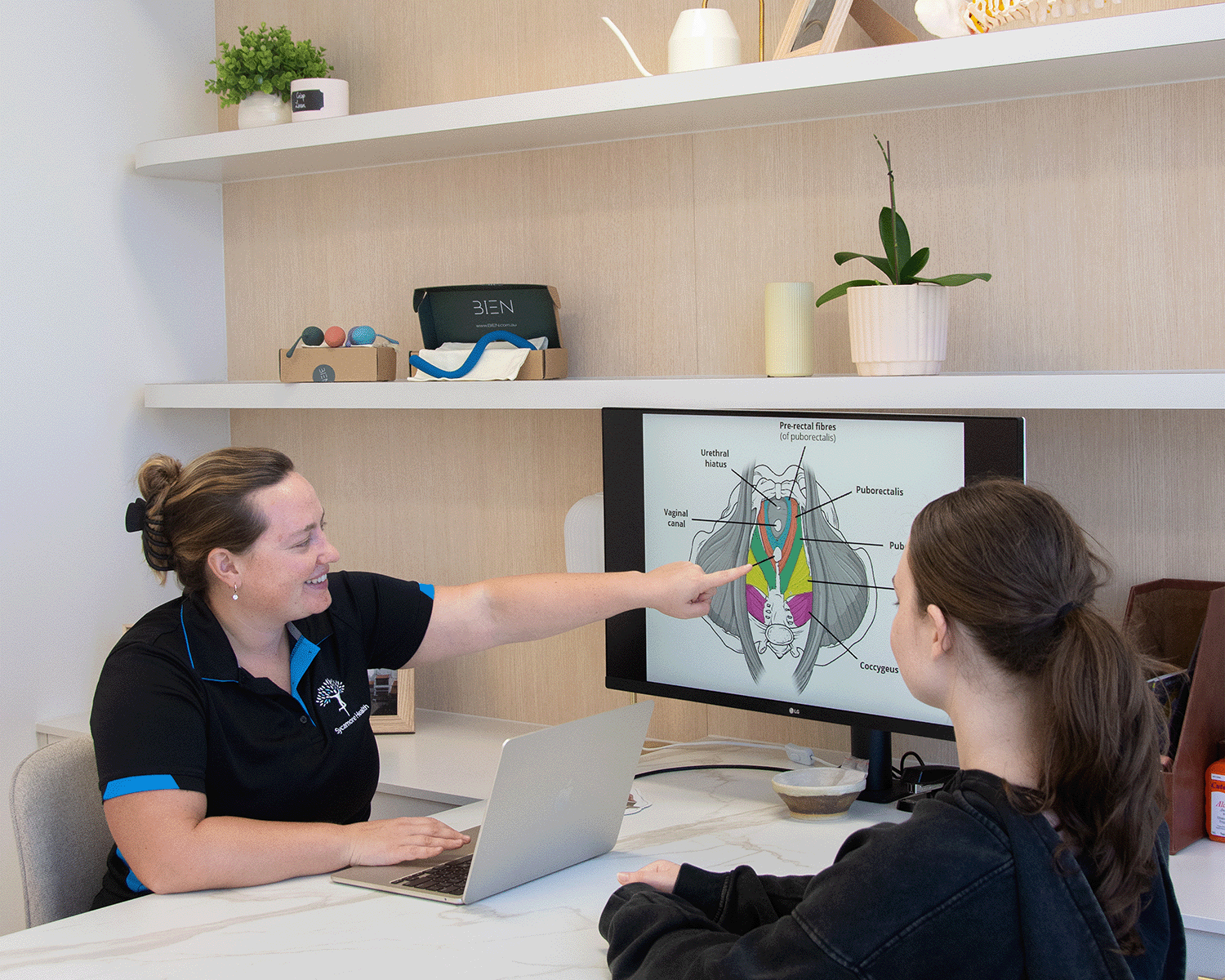
Booking your first women’s health physiotherapy appointment can feel daunting. If you are experiencing bladder leaks, pelvic pain, constipation, or prolapse symptoms, you already have enough on your mind. Adding the uncertainty of what actually happens during the consult can make taking that first step feel nerve-wracking.
Here is the most important thing to know upfront: you are always in total control. Nothing happens without your explicit consent, and an internal examination is never mandatory. We have plenty of assessment and treatment options, and you will work with your physiotherapist to determine which options will be best to suit your presentation.
Let’s walk step-by-step through what you can expect during your initial consultation so you can walk into our clinic feeling confident and at ease.
Step 1: The In-Depth Conversation
We will talk about:
- Your primary concerns, symptoms, and daily goals.
- Your bladder, bowel, and sexual health history.
- Obstetric history (pregnancies, birth experiences, or current pregnancy status).
- Exercise habits, work routine, and overall medical history.
Step 2: Whole-Body Movement & Core Assessment
Depending on your symptoms, we may check:
- Your standing posture and breathing mechanics.
- Lumbar spine and hip mobility.
- Abdominal wall strength and separation (diastasis recti).

Step 3: Choosing Your Preferred Assessment Option
- What it is: A completely non-invasive imaging tool placed gently over your lower abdomen (just like a baby scan).
- How it works: Real-Time Ultrasound allows both you and your physio to view your bladder base and pelvic floor on a screen in real time. At both our Sippy Downs and Morayfield clinics, we use RTUS to watch how your pelvic floor contracts and lifts, measure muscle endurance, and ensure you aren't accidentally bearing down when trying to squeeze.
- What it is: An external, non-internal physical assessment of the perineum (the area between the vagina and anus).
- How it works: Your physio observes the movement of the perineal area while you cough, squeeze, or relax. We can also gently palpate the external anatomy to feel for muscle activation or tension.
- What it is: A direct assessment used when muscle grading, tissue tension evaluation, or prolapse staging is helpful.
- How it works: There are no metal speculums, hard tables, or stirrups. You lie comfortably on a cushioned treatment table covered by a sheet. The physio wears gloves, uses water-based lubricant, and gently uses a single finger to perform assessments. Prior to consenting to an internal examination, your physiotherapist will use a model to demonstrate what to expect so that you can make an informed decision.
Demystifying Consent: Consent is ongoing, flexible, and completely up to you. You can choose Real-Time Ultrasound, decline a physical exam, change your mind mid-way through, or ask to pause at any point.
Step 4: Your Personalised Management Plan
Your initial plan might include:
- Targeted pelvic floor & core exercises: Tailored to whether your muscles need strengthening, lengthening, or relaxation.
- Bladder or bowel retraining strategies: To eliminate urgency or straining. This may also include completion of a bladder diary.
- Targeted movement strategies & soft tissue work: Diaphragmatic breathing, posture adjustments, and hands-on soft tissue release to ease pelvic tension and calm hyper-sensitive nerves.
- Lifestyle and exercise modifications: Keeping you active safely.

Take the First Step with Confidence
Whether your goal is returning to heavy lifting, managing bone density, or simply walking around the block without leaking, your physio can coordinate with our broader team to guide your full recovery.
Ready to take the first step? Our women's health physiotherapists provide 1-on-1 consultations in private treatment rooms at both our Sippy Downs and Morayfield locations.
Book online or call our reception team today on (07) 3046 1700 (Morayfield) or (07) 3046 1702 (Sippy Downs).